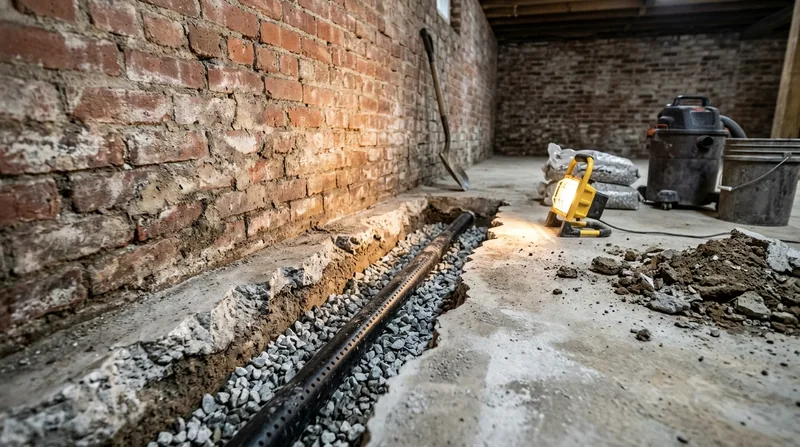




In Trenton, water in the basement rarely comes from one obvious crack. It seeps up through the cove joint where the slab meets the wall, pushes through brick and stone cellars in Chambersburg and Mill Hill, and pools in the low corners of 1950s ranches out in Villa Park. That is hydrostatic pressure from Piedmont clay and silt sitting on top of weathered shale, and it gets worse every spring when the water table climbs. An Interior Drain Tile System in Trenton intercepts that water at the footing before it ever reaches your floor. We cut the slab edge, lay perforated pipe in washed stone, and tie it to a sump basin that pumps the water out and away. It works in any season, which matters in a city where the ground stays wet from March through May. If you are still comparing options, start with our basement waterproofing overview before you commit to a method.
Why Interior Drain Tile Matters in Trenton's Clay and Old Cellars
Trenton sits on glacial clay and silt over shale and diabase, and that soil holds water instead of draining it. The Delaware River and Assunpink Creek flood low streets during big storms, and the water table stays high through spring. In the 1880s brick rowhouses of Mill Hill and Downtown, the old clay footing drains are crushed or root-filled, so water backs up under the slab. Around Cadwalader Park and Hiltonia, partly finished basements show efflorescence and a musty smell within a day of a summer downpour. An interior perimeter drain captures that water at the footing and sends it to a sump basin, which is the proven answer when the problem is hydrostatic pressure rather than a single wall crack.
- Weep holes and cove joint seepage show up first in stone and brick cellars where parging has failed.
- Clay soil around Hamilton and Robbinsville subdivisions pushes water toward footing drains that cannot keep up.
- Winter freeze-thaw cycles open hairline cracks that let water in when the spring thaw arrives.
- Old clay weeping tile in pre-1940 homes is often collapsed, so the drain tile has to be replaced, not just cleaned.
If you see any of these signs, the drain tile is the first thing we check, not the last.
Key info: A homeowner in Mill Hill called us after every heavy rain left an inch of water along the front wall of a 1910 brick rowhouse. The old clay footing drain was crushed under the slab. We installed an interior perimeter drain and a new sump basin, and the floor stayed dry through the next Assunpink Creek flood watch.
For official guidance on permits and contractor licensing in New Jersey, check the NJ Department of Community Affairs, Division of Codes and Standards before any work begins.
How We Install an Interior Drain Tile System in Trenton Homes
We start with a free basement inspection, because the right system depends on the wall type and the water source. In a 1920s brick bungalow near Cadwalader Park, we look for failing parging and efflorescence before we cut anything. In a 1990s poured-wall basement in Hopewell, we check the cove joint and the existing sump pit. Then we lay out the drain line, set the sump basin at the low corner, and plan the discharge line so it clears the foundation and does not freeze. The work is dusty and loud for a day or two, but it is below grade and does not touch your finished rooms.
- We break and remove a 12 to 16 inch strip of slab along the interior perimeter wall.
- We dig down to the footing and shape the trench so water flows by gravity to the sump basin.
- We lay perforated drain tile in washed stone and cover it with filter fabric to keep clay silt out.
- We set the sump basin, connect the drain line, and install a check valve on the discharge.
- We patch the concrete back flush and leave the basement ready for your floor covering.
Every job ends with a wet test, so you see the sump pump cycle before we pack up.
Key info: In a 1965 split-level in Villa Park, the low corner collected water every March. We tied the interior drain to a new sump basin and ran the discharge line to a dry well 12 feet off the foundation, clear of the freeze line. If your sump pump is older, pair the drain with a sump pump installation so the system has a reliable pump from day one.
Interior Drain Tile Approaches We Use in Trenton
Not every basement gets the same drain. The wall material, the footing depth, and whether the floor is finished all change the approach. Here is how we match the method to the house.
| Approach | Description | Best for |
|---|---|---|
| Full interior perimeter drain | Perforated pipe in washed stone along all interior walls, tied to a sump basin. | Whole-basement seepage in brick and stone cellars. |
| Partial drain on the wet wall | Drain run only along the wall that shows seepage, connected to the sump. | One-sided water problems in finished basements. |
| Drain tile replacement | Remove collapsed clay weeping tile and install new perforated pipe and stone. | Pre-1940 homes with failed original footing drains. |
| Drain plus vapor barrier | Interior drain combined with a wall vapor barrier to control humidity. | Damp, musty basements with efflorescence on the walls. |
We tell you plainly which row fits your house, and we do not sell a full perimeter drain when a partial run will do the job.
Interior Drain Tile System Cost in Trenton: What to Expect
Most Trenton interior drain tile work starts at From $50 per linear foot, and that figure covers the slab cut, the trench, the perforated pipe, washed stone, filter fabric, and the concrete patch. A typical rowhouse in Chambersburg with 60 to 80 linear feet of wall falls in a predictable range. A full basement in a Robbinsville subdivision with 120 linear feet and a finished floor costs more because there is more slab to cut and restore. The sump basin, pump, and discharge line are usually priced as a package, and a battery backup adds to that line. The variables that move the number most are wall length, footing depth, whether old clay tile has to come out, and how much concrete restoration you want.
Get two or three written estimates and compare the scope line by line, not just the bottom line. A low bid that skips the filter fabric or the check valve is not the same job. Our full pricing overview breaks down the line items so you know what you are comparing.
Choosing a Waterproofing Contractor Near Me in Trenton
Interior drain tile is only as good as the crew that installs it. Ask for the license and insurance certificate before anyone walks into your basement, and confirm the policy covers below-grade work. Get at least two estimates, ask for references from Trenton addresses, and call one. Ask whether the permit for altering drainage or the sump discharge is pulled by the contractor, because thresholds vary by jurisdiction and the local building department has the final word. If you are in a rowhouse with shared walls, ask how they protect the neighbor's side. Our contact page is the fastest way to schedule a free inspection and get a written scope.
Interior Drain Tile System in Trenton: Pricing Guide
| Service | Price | Details |
|---|---|---|
| Partial interior drain on one wet wall | Starting at $50/linear ft | Covers slab cut, trench, perforated pipe, washed stone, filter fabric, and concrete patch on the affected wall. |
| Full interior perimeter drain | Starting at $50/linear ft | All interior walls tied to a sump basin; price rises with wall length and footing depth. |
| Drain tile replacement with old clay removal | On estimate | Collapsed clay weeping tile must be excavated and hauled out before new pipe goes in. |
| Sump basin, pump, and discharge package | On estimate | Basin, pump, check valve, and discharge line priced together; battery backup adds a line item. |
| Travel | Included | In Trenton and surrounding areas, no separate call-out or mileage fee. |
| Estimate | Free | Response within 24h at (609) 422-5457, no obligation to book. |
Indicative pricing, the exact cost depends on square footage, finish, and site access. Free personalized estimate within 24h at (609) 422-5457.


