



Foundation Waterproofing in Trenton: Built for Piedmont Clay and Old Brick Cellars
When you need Foundation Waterproofing in Trenton, the ground under your house tells the story before we ever open a trench. Trenton sits on Piedmont clay and silt over weathered shale and diabase, and that clay holds water like a sponge through every spring. The 1880s to 1920s brick rowhouses in Chambersburg, Mill Hill and Downtown were built with stone, brick or early block cellars and old clay footing drains that have long since collapsed or silted shut. The 1920s to 1940s bungalows and colonials around Cadwalader Park, Hiltonia and Wilbur often have partly finished basements sitting on the same water table. Add the Assunpink Creek and Delaware River low streets during big storms, plus summer downpours running fast off the hills, and you get hydrostatic pressure pushing water through every hairline and mortar joint. We match the treatment to the foundation type, not to a sales script, and we start with a free basement inspection so you know what you are actually dealing with.
Why Foundation Waterproofing Matters on Trenton's Clay and Old Footing Drains
Trenton foundations fail in a few predictable ways, and the age of the house points to which one you are likely facing. Pre-1920 rowhouses in Mill Hill and Downtown were never built with a modern waterproof membrane, so water moves straight through the brick and stone. The 1950s to 1970s split-levels and ranches in Villa Park and Glen Afton sit on poured walls that crack at the cold joint and the tie holes. The 1990s to 2020s subdivisions in Hamilton, Hopewell and Robbinsville have poured full basements with modern drain tile that still clogs when clay fines wash in. Freeze-thaw cycles every winter open hairline cracks a little wider each year, and spring rain finds them.
- Hydrostatic pressure from saturated glacial clay soil pushes water through mortar joints and block cores.
- Old clay footing drains in pre-1920 cellars collapse or root-in and stop carrying water away from the wall.
- Efflorescence and white salt bloom on the wall tells you water is moving through the masonry, not just condensing.
- Winter freeze-thaw cycles widen hairline cracks in poured and block walls.
- Downspouts that dump next to the foundation recharge the soil right at the footing.
Sorting out which of these is actually driving the wet basement saves you from paying for the wrong repair.
Key info: A 1912 brick rowhouse in Chambersburg with a stone cellar wall and a wet floor after every storm usually needs drainage correction at the footing, not another coat of paint on the wall. A 1968 ranch in Villa Park with one vertical crack and a dry floor usually needs epoxy injection and nothing more. We tell you which one you have before we quote anything.
For official guidance on construction and property maintenance requirements in the city, check the City of Trenton website and confirm current rules with the local building department before work begins.
How We Diagnose and Waterproof a Trenton Foundation, Step by Step
Every job starts with reading the house, not with a product. We walk the basement, check the wall type, map where the water enters, and test the footing drain if one exists. We look at grading and downspout discharge on the outside, because half the water in a Trenton basement starts within six feet of the wall. Then we pick the method that fits the foundation and the budget.
- We inspect the interior walls, floor joint, window wells and any visible crack, and we note efflorescence patterns.
- We check the exterior grade, downspout extensions and the condition of the old footing drain or weeping tile.
- We identify the water source: hydrostatic pressure, a failed drain tile, a wall crack, or surface runoff.
- We recommend the least invasive repair that solves the actual problem, whether that is injection, parging, membrane, or an interior perimeter drain.
- We pull any permit the local building department requires before we cut or alter drainage.
- We complete the work, test it with water, and walk you through what we did and what to watch.
That sequence keeps small problems small and puts the money where the water actually is.
Key info: On a 1948 colonial near Cadwalader Park, we found the wall was sound but the downspout dumped into a buried clay leader that had collapsed. Extending the discharge and correcting the grade around the foundation dried the basement without any excavation. On a 1920s rowhouse in Mill Hill, the same wet floor needed an interior perimeter drain and a sump basin because the footing drain was gone. Same symptom, different fix.
If the diagnosis points to a wall crack rather than a drainage problem, we move to foundation crack repair and inject it properly instead of selling you a full system you do not need.
Foundation Waterproofing Methods We Use on Trenton Foundations
Different foundation types and different water sources call for different approaches. The table below shows what we use and when, so you can see why a rowhouse in Downtown and a 2005 colonial in Robbinsville rarely get the same treatment.
| Approach | Description | Best for |
|---|---|---|
| Epoxy or polyurethane injection | We drill injection ports along the crack and fill it from the inside, sealing the full depth of the wall. | Hairline to quarter-inch cracks in poured and block walls, especially after freeze-thaw. |
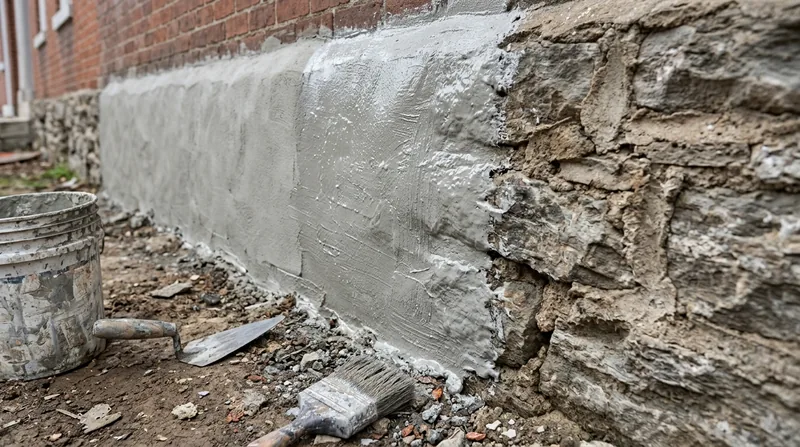
| Parging and masonry repair | We repoint mortar joints and apply a proper parge coat to stone and brick cellar walls. | Pre-1920 stone and brick cellars in Mill Hill, Downtown and Chambersburg. |
| Waterproof membrane and dimple board | We apply a waterproof membrane to the exterior wall and protect it with dimple board before backfill. | Exterior access jobs where the wall is open and the footing drain needs replacement. |
| Crystalline waterproofing | We apply a crystalline treatment that grows into the concrete pores and blocks water passage. | Damp poured and block walls with no single crack to inject. |
| Interior perimeter drain and sump basin | We cut a channel at the floor edge, install drain tile to a sump basin, and discharge through a check valve. | Hydrostatic pressure and failed footing drains where exterior excavation is not practical. |
We pick from this list based on the wall material, the water source and the access, and we explain the reasoning before you commit.
Foundation Waterproofing Cost in Trenton: What to Expect
Most Trenton homeowners want a number before they want a lecture, so here is the honest version. Foundation waterproofing starts around $3,500 for a targeted repair such as crack injection plus grading and downspout correction on a single wall. A full interior perimeter drain with a sump basin and discharge line runs higher, and exterior excavation with membrane and new footing drain is the top of the range. The gap between those numbers is real, and it comes down to the foundation type and the water source.
- Foundation type and age: a stone cellar wall in Mill Hill takes more labor than a 2005 poured wall in Robbinsville.
- Access: a Downtown rowhouse with a shared wall and no side yard limits equipment and raises labor.
- Water source: a single crack is cheap to fix, hydrostatic pressure across a whole wall is not.
- Drainage condition: replacing a collapsed clay footing drain adds scope that a simple seal does not.
- Permits: structural repair and drainage alterations may require a permit from the local building department.
Get two or three written estimates with the same scope so you can compare apples to apples, and be suspicious of a quote that does not name the water source. Our full pricing overview breaks down the ranges by method.
Foundation Waterproofing Near Me: How to Choose a Contractor Near Trenton
You will find plenty of names when you search for foundation waterproofing near me, and not all of them specialize in below-grade work. A general foundation firm, a plumber and a dedicated waterproofing contractor are three different trades with three different scopes. Here is what to check before you sign.
- Confirm the contractor is licensed and insured and ask for a certificate of insurance before work starts.
- Get at least two or three written estimates that name the water source and the method, not just a price.
- Ask for local references from jobs on the same foundation type as yours, ideally in Trenton or Hamilton Township.
- Ask who pulls the permit for structural repair or drainage alteration, and verify the requirement with the local building department.
- Check whether your neighborhood or HOA has rules about exterior work, discharge lines or equipment access.
A contractor who explains why your basement is wet, and what the cheapest correct fix is, is the one worth hiring. Reach us through the contact page to set up a free inspection.
Foundation Waterproofing in Trenton: Pricing Guide
| Service | Price | Details |
|---|---|---|
| Crack injection (epoxy or polyurethane) | Starting at $3,500 | Includes port drilling, full-depth injection and water test; wall length and crack count move the price. |
| Parging and masonry repair | Starting at $3,500 | Includes mortar repointing and parge coat on stone or brick; wall height and access drive the cost. |
| Exterior membrane and footing drain | On estimate | Includes excavation, membrane, dimple board and drain replacement; depth and access require an on-site look. |
| Interior perimeter drain and sump basin | On estimate | Includes channel cutting, drain tile, sump basin and discharge; linear footage and pump choice set the number. |
| Travel | Included | In Trenton and surrounding areas, no separate call-out or mileage fee. |
| Estimate | Free | Response within 24h at (609) 422-5457, no obligation to book. |
Indicative pricing, the exact cost depends on square footage, finish, and site access. Free personalized estimate within 24h at (609) 422-5457.


