



Bowing Wall Repair in Trenton
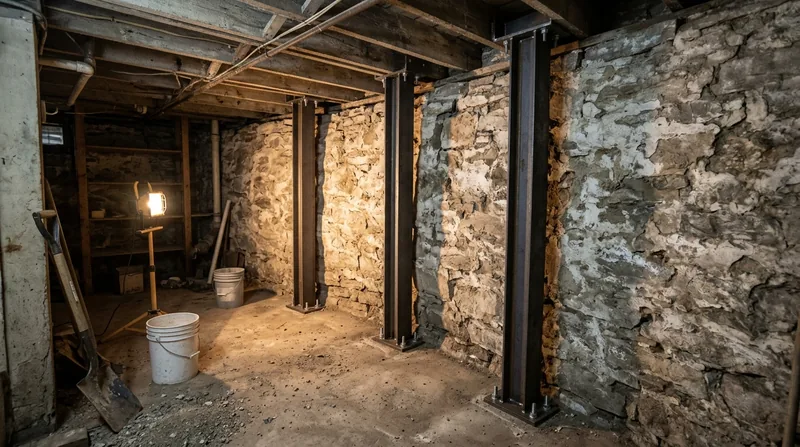
If you have noticed a bowing wall repair in Trenton problem, you are not alone. The city's 1880s-1920s brick rowhouses in Chambersburg and Mill Hill sit on stone and brick cellars that have been pushed inward by Piedmont clay for a century. Around Cadwalader Park and Hiltonia, 1920s-1940s brick bungalows show the same lean after wet springs. The clay and silt over weathered shale holds water, and hydrostatic pressure does the rest. We stabilize leaning walls with carbon fiber straps, steel I-beams, or wall anchors, matched to how far the wall has moved. Start with a free basement inspection so we can measure the bow before anything else.
Why Bowing Walls Are Common in Trenton's Older Cellars
Trenton's ground is glacial clay and silt over shale and diabase, and the water table stays high through spring. That clay swells when wet and pushes hard against a basement wall. Older stone and early block walls in Mill Hill and Downtown were never built for that load. In the 1950s-1970s ranches of Villa Park and Glen Afton, the same pressure shows up as horizontal cracks and a wall that leans in at the top. Fast runoff from the hills after a summer downpour sends water to footing drains that are often old clay tile and already collapsed.
- Horizontal cracks in a block wall usually mean the wall is bowing, not just settling.
- Stair-step cracks in brick or block follow the mortar joints as the wall rotates inward.
- A wall that leans more than 1 inch over 8 feet needs stabilization, not paint.
- White efflorescence and a musty smell point to water moving through the wall.
If you see any of these, get the wall measured before the next wet season.
Key info: A 1918 brick rowhouse off South Broad in Chambersburg had a rear cellar wall leaning 2 inches. The cause was a blocked clay footing drain and clay that never dried out. We installed carbon fiber straps and restored drainage, and the wall has held.
For permit questions on structural foundation work, the City of Trenton's construction office is the authority to check before any repair begins. Rules vary by block and by scope, so verify with them directly: City of Trenton official site.
How We Diagnose and Stabilize a Leaning Wall in Trenton
We do not guess at a bowing wall. The first step is to find out what is pushing the wall and how far it has moved. We check the wall with a level and a plumb line, map the cracks, and look at the soil side to see whether water is trapped. Then we match the repair to the severity. A wall that has moved less than an inch often needs carbon fiber straps. A wall that has rotated further may need steel I-beams or wall anchors driven into the soil outside.
- We inspect the wall inside and out and record the crack widths and the amount of lean.
- We check the footing drain and the grading to find where water is collecting.
- We recommend carbon fiber straps, steel I-beams, or wall anchors based on the movement.
- We install the system and, where needed, correct the drainage so the pressure drops.
- We re-check the wall after the work and give you a written summary of the repair.
Every repair ends with a drainage check, because a stabilized wall still fails if the clay stays saturated.
Key info: In a 1962 split-level in Villa Park, the front basement wall had a horizontal crack and a 1.5-inch bow. We installed five carbon fiber straps and tied the repair to a new interior perimeter drain. The wall has not moved since.
If the wall is sound but water is the problem, an interior drain tile system is often the better answer than exterior excavation. We tell you plainly when that is the case.
Bowing Wall Repair Methods We Use in Trenton
Not every leaning wall needs the same fix. The table below shows the methods we use and when each one fits. We pick the method after we measure the wall, not before.
| Approach | Description | Best for |
|---|---|---|
| Carbon fiber straps | Straps epoxied to the wall and anchored top and bottom to stop further bowing. | Block or poured walls with less than 2 inches of movement. |
| Steel I-beams | Vertical beams set against the wall and tied into the floor and joists. | Long walls with moderate bowing and no room to excavate outside. |
| Wall anchors | Steel plates on the inside tied to anchors driven into stable soil outside. | Walls that have rotated more than 2 inches and need pulling back. |
| Drainage correction | New footing drain, interior perimeter drain, or grading to relieve pressure. | Any wall where water is the driving force behind the movement. |
Bowing Wall Repair Cost in Trenton: What to Expect
Most bowing wall repairs in Trenton start at $600 for a small job, such as a single strap on a short wall or a targeted crack repair tied to a drainage fix. A full stabilization with multiple carbon fiber straps or steel I-beams typically runs into the low thousands. The price moves with the length of the wall, how far it has bowed, whether the footing drain needs work, and how hard it is to reach the wall inside a finished basement.
We give you a written scope before we start. Get two or three estimates and compare what is actually included, not just the bottom line. A low number that skips the drainage correction will not stop the wall from moving again. Our pricing page lays out the ranges so you can compare apples to apples.
Key info: A homeowner in Hiltonia was quoted a full exterior excavation by one contractor. We measured the wall, found less than an inch of movement, and stabilized it with carbon fiber straps plus a downspout extension. The lower-cost repair was the correct one.
Finding a Bowing Wall Repair Contractor Near Me in Trenton
Hiring the right contractor matters more than the brand of strap. Ask for proof of license and insurance, and call the references. Ask whether the company will pull the permit if the work is structural; in Trenton, that depends on the scope and the building department's call. Get at least three estimates in writing, and make sure each one says whether drainage work is included. A contractor who only sells straps and never mentions water is not solving the problem.
Reach out through our contact page to schedule a look at your wall.
Bowing walls do not fix themselves, and Trenton's clay keeps pushing every spring. Call Trenton Waterproofing at (609) 422-5457 for a free basement inspection and a straight answer on what your wall needs.
Bowing Wall Repair in Trenton: Pricing Guide
| Service | Price | Details |
|---|---|---|
| Carbon fiber strap repair (single wall) | Starting at $600 | Includes straps, epoxy, and anchoring for a short wall with minimal movement; price rises with wall length and number of straps. |
| Steel I-beam stabilization | Starting at $1,800 | Includes beams tied into floor and joists; price moves with wall height, access, and whether a finished basement must be opened. |
| Wall anchor system | On estimate | Requires exterior excavation and soil assessment; we quote after measuring the lean and checking the footing drain. |
| Drainage correction add-on | Starting at $900 | Includes footing drain repair or interior perimeter drain to relieve hydrostatic pressure; priced by linear feet and site access. |
| Travel | Included | in Trenton and surrounding areas, no separate call-out or mileage fee. |
| Estimate | Free | Response within 24h at (609) 422-5457, no obligation to book. |
Indicative pricing, the exact cost depends on square footage, finish, and site access. Free personalized estimate within 24h at (609) 422-5457.


